

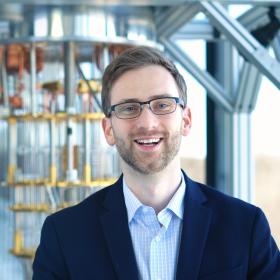

Ever since he was a child, Zlatko Minev ’18 PhD has looked to scientists and engineers as his inspirational lodestars. “Nikola Tesla unearthed something about nature at a deep level and seized that power to create a new science that was helpful to humanity. He solved a problem once deemed impossible,” says Minev. “In science, that is my goal too.”
While studying physics at UC Berkeley as an undergraduate, Minev conducted research in a new quantum computing lab, merging his two great passions, quantum physics and computer science. He soon learned that one of the birthplaces of superconducting qubit technology was Yale University. “I got the sense that if there’s an institution at the edge of what’s current in chip-based quantum computing, it’s Yale,” Minev says.
He arrived on campus in 2011 to pursue a PhD in applied physics, working in the Yale Quantum Lab with Michel Devoret, who was awarded the Nobel Prize in Physics in 2025. “I grew a ton and learned a lot,” Minev recalls. “Research and learning were focused not just on applications but on rigorously understanding the foundational science underlying them.”
A Revolutionary Discovery
During his fifth year as a Yale PhD student, Minev devised an experiment that overturned a mainstay of quantum mechanics—one that had troubled Erwin Schrödinger, Neils Bohr, and Albert Einstein one hundred years ago.
“I had already published papers and could have graduated at that point and gotten a job,” says Minev. “But I started this new experiment, even with a lot of the world’s experts saying, ‘I’m not sure this will work. Likely, it’s not even possible in our lifetime.’ With the support and flexibility of a Yale fellowship, I dedicated an extra two years to a project that would either crash and burn or have a slim chance of being something truly exciting.”
At the core of quantum physics are discreteness and randomness, as exemplified by the phenomenon of a quantum jump, an atomic particle’s sudden transition from one of its discrete energy states to another. These ubiquitous and fundamental shifts happen unpredictably and instantaneously. Particles appear to leap from one energy state to another, spending no time in between.
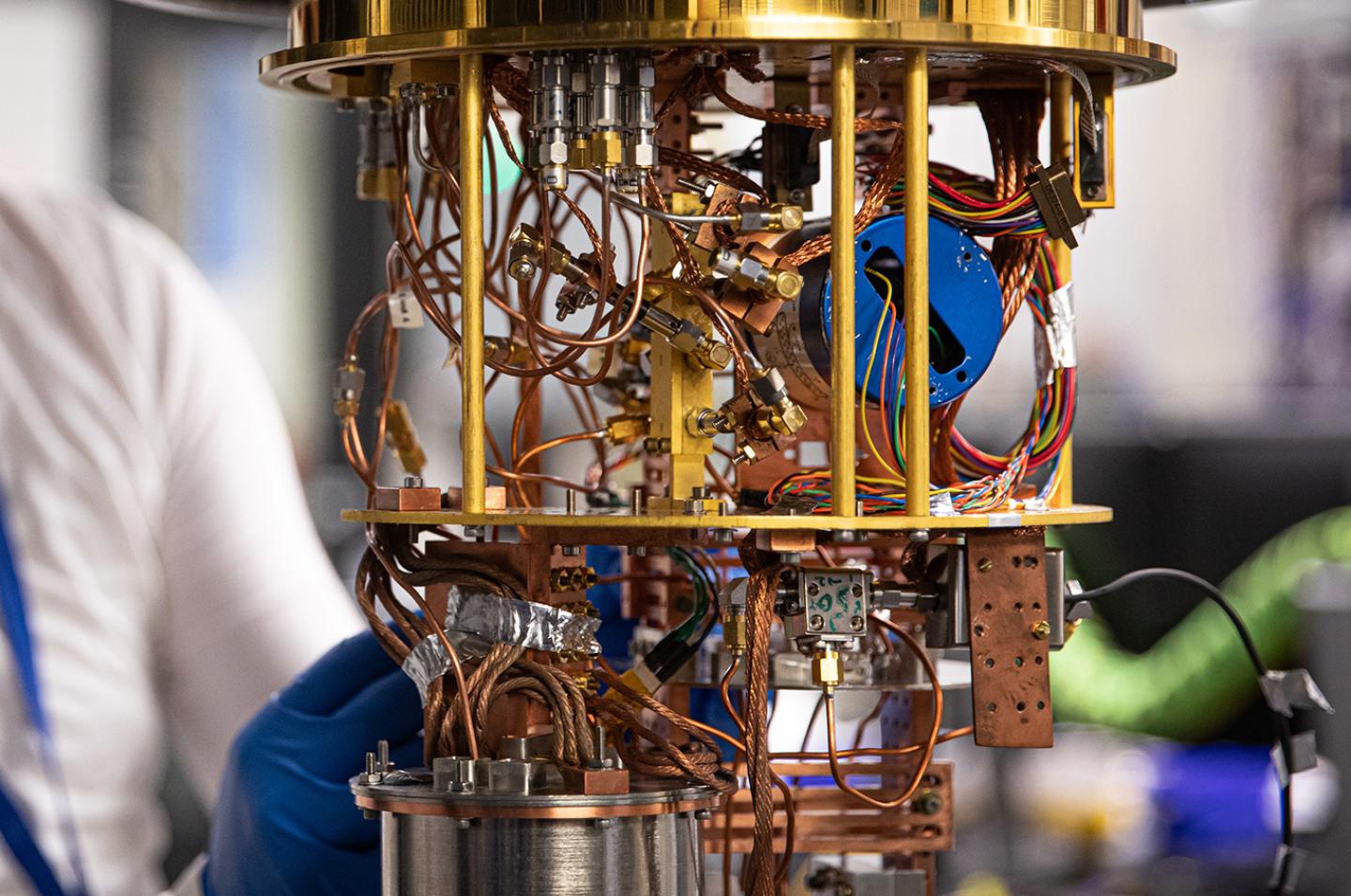
Using technology newly developed at Yale during his dissertation, Minev’s experiment allowed him to peer into the actual workings of a quantum jump for the first time. The results showed a surprising finding that contradicted the established view—the jumps are neither abrupt nor as random as previously thought. What’s more, Minev’s experiment could predict when a quantum jump was about to happen, “catch” it halfway through, and even reverse it, thus preventing it from ever occurring.
His discovery, which was published in Nature, marked a major advance in our ability to understand and control quantum information. Reliably managing quantum data and correcting errors as they occur has been a key challenge in the development of fully useful quantum computers.
Pushing the Field Forward
Since earning his PhD, Minev has continued on the mission to bring useful quantum computing to the world. At IBM he founded and led the company’s Qiskit Leap team, which focused on demonstrating the best science achievable with quantum computing. He also founded and led Qiskit Metal (now Quantum Metal), the first full-stack open-source platform for designing superconducting quantum chips.
In 2025, he returned to California to join Google Quantum AI, where he leads application-focused teams working at the intersection of precision calibration and quantum error mitigation, with the goal of turning quantum processors into practical scientific instruments.
“This work is helping transform quantum hardware from experimental devices into reliable instruments for discovery,” he says. “My role has increasingly shifted toward combining deep science with team building and ecosystem development to create environments where researchers and engineers can collectively push the field forward.”
Last fall, Google Quantum AI announced research that shows for the first time in history that a quantum computer can successfully run a verifiable algorithm on hardware that surpasses even the fastest classical supercomputers. This breakthrough has brought quantum computers even closer to becoming tools that will drive major discoveries in areas like medicine and materials science.
Minev says that for future discoveries to be made, it’s essential to support the next generation of scientists. He has led numerous science outreach initiatives for students and recently co-founded the Quantum Device Workshop at UCLA, a program developed to train undergraduate and graduate students in the art and practical workflows of quantum-device hardware design. Their first annual workshop brought together four hundred students, researchers, and industry leaders from around the world for collaborative, hands-on learning.
“I’ve been pleasantly surprised by the degree to which all of the things I did at Yale have helped me,” Minev says. “I experienced firsthand that even graduate students can unearth discoveries previously believed to be impossible. That faith, along with the technical knowledge and leadership skills I gained, has been unmatched in its value inside and beyond the laboratory.”